
The healthcare Medicare covers during a hospital observation stay is generally billed as outpatient care under Part B, even when you spend the night in a hospital bed. Having a room, receiving nursing care or eating hospital meals does not make you an inpatient.
That distinction can affect your hospital bill, medication charges and coverage for skilled nursing care after discharge. Hospitals and clinicians submit claims to Medicare, which determines payment under the applicable coverage rules. You may then receive separate bills for your share.
The rules below focus on Original Medicare, with differences for Medicare Advantage explained separately.
Observation status is outpatient care
Observation services help a hospital assess your condition and decide whether to admit you as an inpatient or discharge you. You might receive monitoring, diagnostic tests and treatment while that decision is being made.
An overnight stay is not the same as an inpatient admission. Inpatient status requires a formal admission order. Ask your doctor or hospital case manager which status applies rather than relying on where you sleep.
Medicare’s two-midnight benchmark generally supports inpatient admission when the admitting clinician reasonably expects medically necessary hospital care to span at least two midnights. Exceptions apply, and the admission must meet Medicare’s requirements. Spending two nights under observation does not automatically convert your stay to inpatient status.
Your status can also change during the visit. Request the effective date and time of any change, particularly if discharge planning involves a skilled nursing facility.
Part B costs for healthcare Medicare covers under observation
Under Original Medicare, observation services fall under the outpatient hospital benefit. Medicare’s outpatient hospital coverage guidance explains that hospital services and clinician services can carry separate patient charges.
The main distinction is:
| Hospital status | Coverage for hospital services | Common patient costs | Counts toward the usual three-day inpatient requirement for skilled nursing care? |
|---|---|---|---|
| Outpatient observation | Part B | Part B deductible and applicable hospital copayments or coinsurance | No |
| Formally admitted inpatient | Part A for the covered hospital stay | Part A benefit-period deductible and applicable coinsurance | Qualifying inpatient days can count |
Doctors’ services are generally billed under Part B in either setting. For those services, you usually pay 20% of the Medicare-approved amount after meeting the Part B deductible.
For observation care, the hospital may charge a patient share for multiple outpatient services. Those charges can add up. Do not assume outpatient care will cost less than an inpatient admission, or that the Part A hospital deductible limits your total observation bill.
Original Medicare also has no annual out-of-pocket maximum for Part A and Part B services. Medigap, Medicaid or other secondary coverage may reduce what you owe.
A simple billing example
Suppose your Part B deductible is already met and you have no secondary insurance. In a hypothetical observation stay, your hospital-service cost sharing totals $250. A clinician separately bills a Medicare-approved amount of $200, leaving you with $40 in coinsurance.
Your combined responsibility would be $290 before any separately billed, noncovered items. These figures illustrate the billing structure, not actual Medicare rates or a price estimate.
When estimating your share of healthcare Medicare covers, separate the hospital’s charges from clinicians’ charges. An emergency physician, radiologist or other professional may send a bill independently of the hospital.
Routine medications can create another bill
Many medicines you normally take yourself, sometimes called self-administered drugs, are not covered by Part B when a hospital provides them in an outpatient setting. Some drugs are covered under specific Part B rules, so the medication and circumstances matter.
For example, a routine maintenance pill may be handled differently from a drug administered as part of a covered hospital service.
If you have Part D coverage, you may be able to request reimbursement from your drug plan for eligible medications. Payment depends on the plan’s coverage and claims rules, and the hospital pharmacy may be outside its network. Keep the itemized medication bill and receipts, then ask your plan how to submit a claim.
Do not take medications brought from home without hospital approval. Ask the nurse or pharmacist about the hospital’s medication policy first.
What the Medicare Outpatient Observation Notice tells you
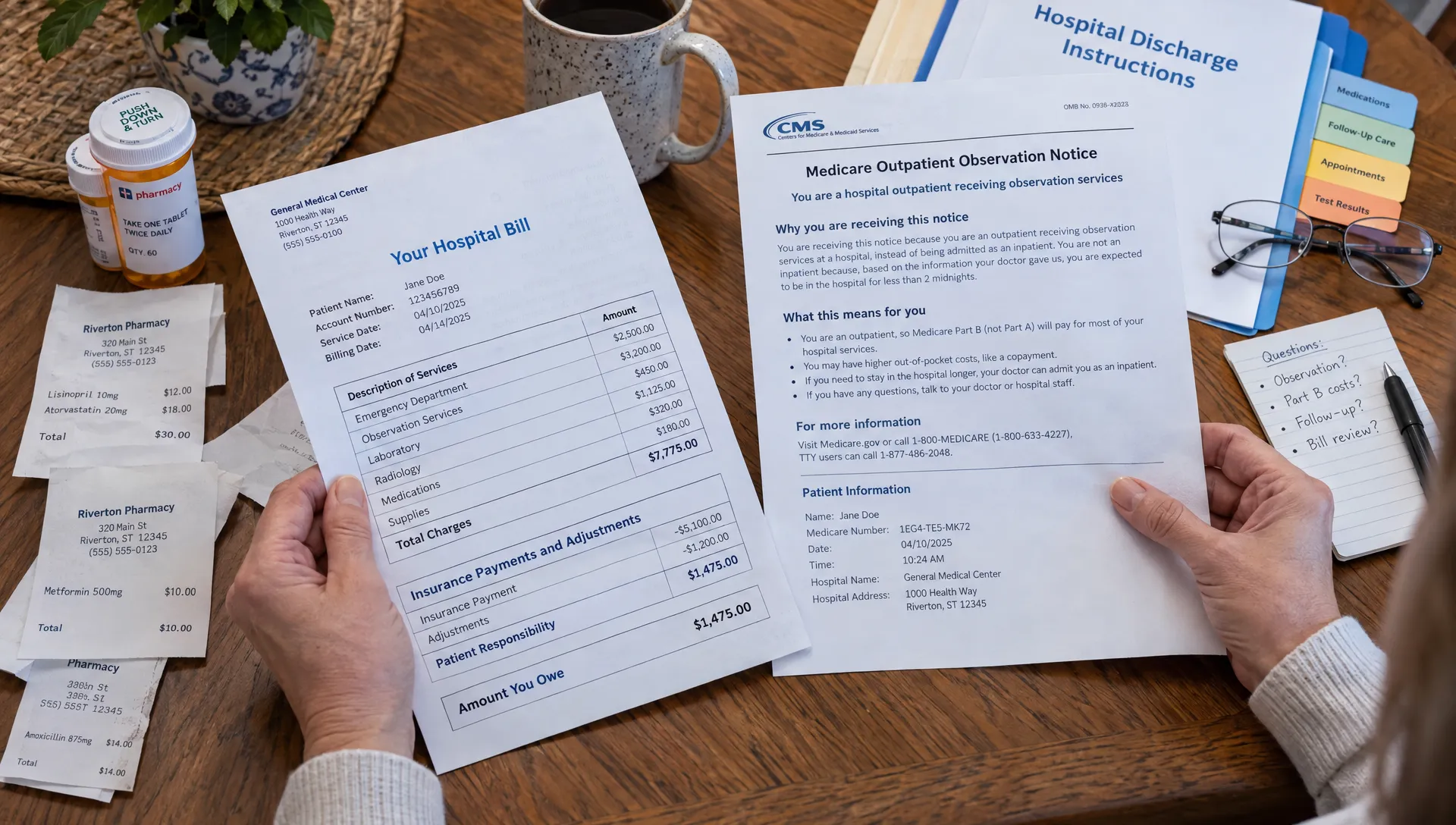
The Medicare Outpatient Observation Notice, or MOON, explains that you are receiving observation services as an outpatient and describes the financial implications.
For healthcare Medicare covers under observation, this notice is an important explanation of status, not an estimate of your final bill.
Hospitals must provide the MOON when observation services last more than 24 hours. It generally must be delivered no later than 36 hours after observation begins, or sooner if you are discharged or transferred before then. The requirement applies to Original Medicare and Medicare Advantage patients.
The hospital must also provide an oral explanation. Ask for clarification if the notice does not match what you understood about your admission.
Signing acknowledges receipt; it does not mean you agree with the classification. Keep a copy with your discharge papers. Also ask whether your status has changed since the notice was issued, because the MOON alone may not tell the whole story of a longer stay.
How observation affects skilled nursing facility coverage
Observation status also affects healthcare Medicare may cover after discharge. Under Original Medicare, a covered skilled nursing facility stay usually requires a qualifying hospital stay of at least three consecutive inpatient days. The hospital discharge day does not count.
Time in the emergency department or under outpatient observation does not count toward that requirement, even when you receive care in the same hospital bed throughout the visit.
For example, two observation nights followed by one inpatient day do not create a three-day qualifying inpatient stay. Meeting the hospital-stay requirement is also only one condition of skilled nursing facility coverage. You must meet the remaining coverage criteria, including needing qualifying skilled care.
Some exceptions exist. Certain Medicare accountable care organization arrangements can waive the three-day requirement, and Medicare Advantage plans may waive it. Ask whether a specific waiver applies rather than assuming one does.
Before agreeing to a nursing facility transfer, have the discharge planner verify your qualifying inpatient dates and expected coverage. A recommendation for rehabilitation does not, by itself, establish Medicare payment eligibility.
If you are arranging care in advance, our guide to Medicare coverage before planned surgery explains why rehabilitation benefits deserve attention alongside the procedure itself.
Can you challenge an observation classification?
Start with the hospital case manager, utilization review team or treating clinician. Ask why observation was selected and whether an inpatient admission is medically appropriate. A request alone does not require the hospital to change your status.
Certain Original Medicare beneficiaries who were initially admitted as inpatients and then changed to outpatient observation may qualify for a special status-change appeal. Eligibility rules apply, so ask whether you should receive a Medicare Change of Status Notice, which is different from the MOON.
For eligible patients, that notice explains appeal options, including how to request expedited review. Follow its instructions immediately if you want a decision while still hospitalized.
A bill for healthcare Medicare covered can also be challenged through the applicable claims appeal process when you disagree with a coverage or payment decision. That is different from requesting an expedited review of an inpatient-to-outpatient status change.
Someone placed in observation from the beginning generally does not have that particular status-change appeal right. They can still question the classification and review subsequent claim decisions through the available procedures. Consult Medicare’s appeal instructions and the notice tied to your situation rather than waiting for a collection letter.
How Medicare Advantage and Medigap change the picture
Medicare Advantage must cover Medicare-covered Part A and Part B services, but your plan’s cost-sharing structure may differ from Original Medicare. An observation visit might involve an outpatient hospital copay, coinsurance or other charges described in the plan’s Evidence of Coverage.
Ask the plan how it handles emergency services, observation care and any later inpatient admission during the same visit. Also verify requirements for post-hospital skilled nursing care, including whether the plan waives the three-day inpatient requirement. Do not assume another person’s plan uses the same rules.
Medigap works differently. It supplements Original Medicare and may pay some covered Part B cost sharing, depending on the policy. It generally does not turn a noncovered service into a covered one or make a nonqualifying skilled nursing stay eligible for Medicare payment.
Private coverage can reduce what you owe for healthcare Medicare covers, but the benefit details matter more than a plan’s headline premium. Our explanation of what Medicare quotes include and leave out can help you compare those details before choosing coverage.
What to check before discharge and before paying
Before leaving the hospital, get a clear answer about your status and any changes during the stay. If another facility will provide your next stage of care, ask the discharge planner to confirm the coverage requirements with that facility and your insurer.
Keep the MOON, any status-change notice, discharge summary and itemized bills together. A short written timeline can help you spot discrepancies later.
When bills arrive, check these items:
- Service dates and status: Confirm which dates were outpatient and which, if any, were inpatient.
- Claim processing: Match charges against your Medicare Summary Notice or Medicare Advantage Explanation of Benefits. These documents are not bills.
- Separate professional charges: Identify clinician bills without assuming every separate bill is a duplicate.
- Medication charges: Ask which drugs were excluded from Part B and whether you can submit a Part D reimbursement claim.
- Secondary insurance: Verify that applicable Medigap, Medicaid or other coverage was processed before paying the remaining balance.
For healthcare Medicare covers, the amount the hospital originally charges is not necessarily the amount you owe. If an item looks wrong, ask the billing office to explain the Medicare-approved amount, payment and patient responsibility. Request a corrected bill when appropriate, while keeping any appeal deadline in view.
If payment is difficult, ask about hospital financial assistance and Medicare Savings Programs. Qualified Medicare Beneficiaries have specific protections against billing for Medicare-covered deductibles, copayments and coinsurance.
Frequently asked questions
Does spending the night mean Medicare considers me an inpatient? No. You can remain an outpatient while receiving observation services overnight. A formal inpatient admission order and applicable coverage requirements determine inpatient status, not the room or length of stay alone.
Does Medicare Part A pay for observation services? Under Original Medicare, outpatient observation services are generally billed under Part B rather than the Part A inpatient hospital benefit. Your hospital and clinicians may submit separate claims.
Does observation count toward three days for skilled nursing facility coverage? Not under Original Medicare’s usual qualifying-stay rule. You generally need three consecutive inpatient days, excluding the hospital discharge day. Some qualifying arrangements and Medicare Advantage plans waive that requirement.
Will Medigap pay my whole observation bill? Not necessarily. A policy may cover some Part B cost sharing for healthcare Medicare covers, depending on its benefits. Noncovered medications and other excluded items can remain your responsibility.
Can I appeal after receiving a MOON? The MOON explains outpatient status but is not itself a claim denial. Special status-change appeal rights may apply if you were admitted as an inpatient and later reclassified. Ask which process applies and follow the deadline on the relevant notice.
Compare coverage with hospital costs in mind
When comparing Medicare coverage, look beyond monthly premiums to outpatient hospital charges, medication rules and post-hospital nursing benefits. Insurance2All offers free, no-commitment comparisons and licensed advisor guidance, including bilingual support. Explore your Medicare coverage options with Insurance2All and ask how each option handles observation stays before enrolling.