If you searched for “plan a medicare,” you may be trying to distinguish two very different types of coverage: Medigap Plan A, a private Medicare Supplement insurance policy, and Medicare Part A, the hospital insurance portion of Original Medicare. They share the letter A, but they do not provide the same benefits.
The key distinction is simple: Medicare Part A helps pay for covered medical services. Medigap Plan A helps pay certain costs left over after Original Medicare pays. You can have both, but one does not replace the other.
Medigap Plan A vs. Medicare Part A at a Glance
Original Medicare consists of Part A and Part B. Medigap policies work alongside that coverage, helping with specified deductibles, copayments or coinsurance, depending on the policy’s letter.
| Feature | Medicare Part A | Medigap Plan A |
|---|---|---|
| Type of coverage | Hospital insurance within Original Medicare | Supplemental insurance that works with Original Medicare |
| Who provides it | The federal Medicare program | A private insurance company |
| Main purpose | Helps cover inpatient hospital care and certain other services | Helps pay selected Original Medicare out-of-pocket costs |
| Monthly premium | Many people qualify for premium-free Part A; others pay a premium | A separate premium set by the insurer |
| Part A hospital deductible | Generally charged for each benefit period | Not covered |
| Prescription drug coverage | Covers certain drugs received during covered inpatient care, not general outpatient prescriptions | Does not provide outpatient prescription drug coverage |
A Plan A Medicare supplement policy is therefore an additional layer of insurance, not another name for hospital coverage. You generally need both Medicare Part A and Part B to buy a Medigap policy.
What Medicare Part A Actually Covers
Medicare Part A helps cover inpatient hospital stays, qualifying skilled nursing facility care, hospice care and certain home health services. Each benefit has eligibility requirements and coverage limits.
For example, Medicare’s inpatient hospital coverage rules require a formal inpatient admission. Spending a night in a hospital does not automatically mean your care falls under Part A. Observation services are generally outpatient care billed under Part B.
Why the Part A Deductible Matters
The Part A inpatient hospital deductible applies per benefit period, not simply once per calendar year. A benefit period generally ends after you have gone 60 consecutive days without inpatient hospital care or skilled nursing facility care.
That means you could owe another deductible if a new benefit period begins during the same year. Hospital coinsurance also applies after the first 60 covered inpatient days in a benefit period, with different rules for lifetime reserve days.
Premium-free Part A does not mean cost-free hospital care. Even when you owe no monthly Part A premium, deductibles and other cost sharing may still apply.
What Plan A Medicare Supplement Insurance Covers
Medigap Plan A provides the basic benefits found in standardized lettered Medigap policies. According to Medicare’s Medigap benefits comparison, Plan A covers:
- Part A coinsurance and hospital costs: This includes up to an additional 365 days of hospital coverage after Medicare benefits are used up, subject to the policy’s terms.
- Part B coinsurance or copayments: This helps with cost sharing for covered physician services, outpatient care and other Part B services.
- Blood: Coverage for the first three pints when applicable under Medicare’s blood benefit rules.
- Part A hospice care coinsurance or copayments: This helps with the beneficiary’s share of covered hospice services.
These benefits are standardized in states that use lettered Medigap plans. A Plan A policy from one insurer has the same standardized benefits as Plan A from another insurer, although premiums and other policy details can differ.
Massachusetts, Minnesota and Wisconsin standardize Medigap coverage differently. Residents of those states should compare their state-specific options rather than assume this lettered-plan description applies unchanged.
What Medigap Plan A Does Not Cover
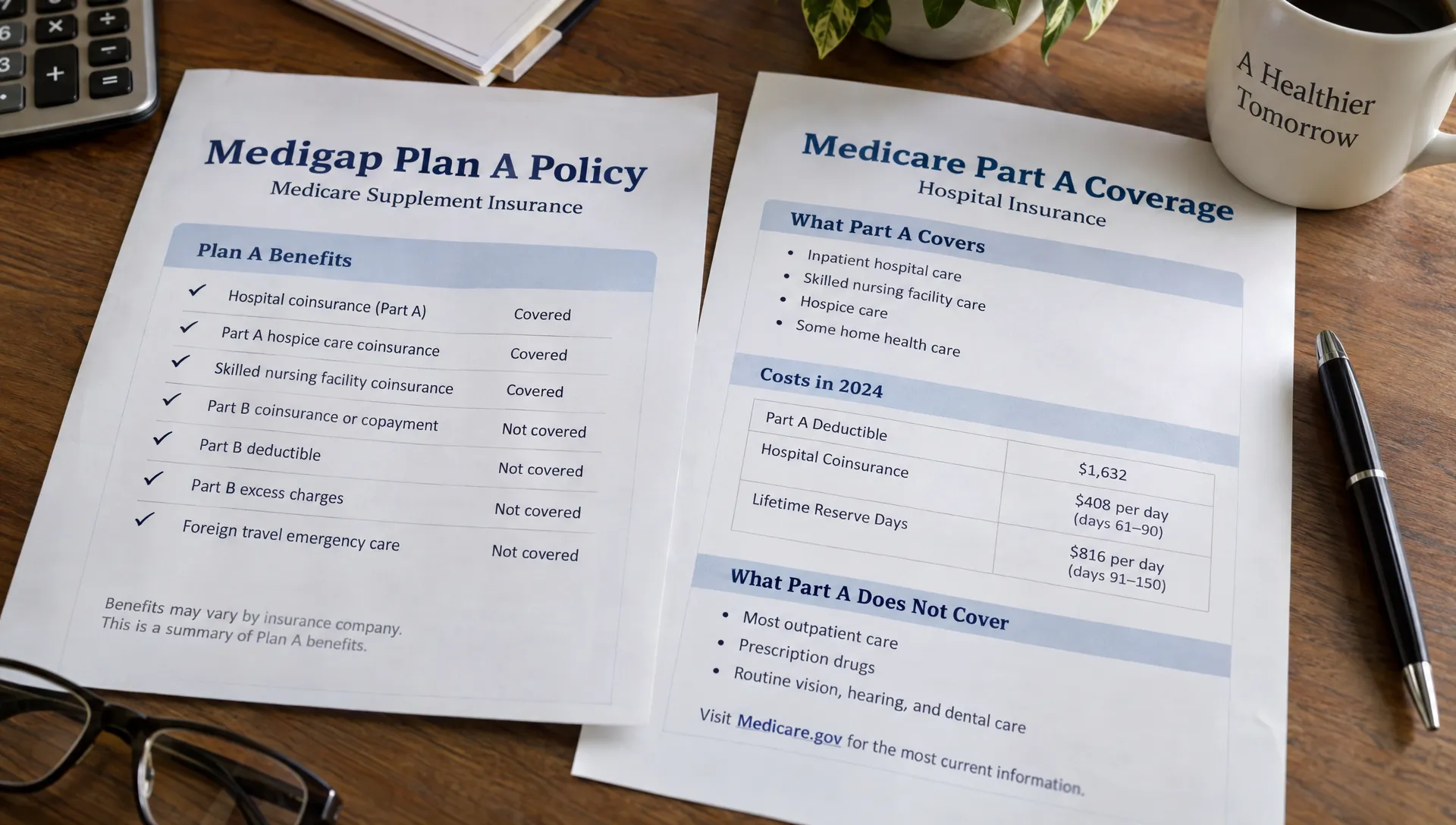
The largest potential misunderstanding concerns the hospital deductible: Plan A does not pay the Medicare Part A deductible. Its hospital coinsurance benefit does not eliminate every hospital-related expense.
A Plan A Medicare supplement policy also leaves several other gaps:
| Expense or benefit | Covered by standardized Medigap Plan A? |
|---|---|
| Medicare Part A deductible | No |
| Medicare Part B deductible | No |
| Skilled nursing facility care coinsurance | No |
| Part B excess charges | No |
| Foreign travel emergency benefit | No |
Part B excess charges can arise when a provider does not accept Medicare assignment and is legally permitted to charge more than Medicare’s approved amount. These are different from ordinary Part B coinsurance.
Medigap also generally does not cover routine dental care, routine vision care, hearing aids or long-term custodial care. It does not turn a service excluded by Medicare into a covered service.
If you want outpatient prescription drug coverage while using Original Medicare, you generally need a separate Part D plan unless you have other qualifying drug coverage.
How the Two Coverages Work When You Receive Care
The difference becomes clearer when you follow a bill through the payment process. Original Medicare pays first for covered services. Medigap then helps with the specific remaining costs included in your policy.
Example: A Covered Doctor Visit
Suppose a covered outpatient service has a Medicare-approved amount of $1,000. For this simplified example, assume your Part B deductible has already been met, the provider accepts assignment and the service uses standard 20% coinsurance.
Part B generally pays $800, leaving $200 in coinsurance. A Plan A Medicare supplement policy would generally cover that $200 coinsurance amount under its standardized benefits.
Medicare Part A would not handle this bill because the service falls under Part B. This is another reason the letters should not be treated as interchangeable.
Example: An Inpatient Hospital Stay
For a covered hospital admission, Part A pays according to Medicare’s inpatient benefit rules. You may owe the Part A deductible, which Medigap Plan A does not cover.
If the stay extends into days when Part A hospital coinsurance applies, Plan A helps pay that covered coinsurance. Its additional hospital-day benefit can also apply after Medicare’s hospital benefits are exhausted.
The practical takeaway is that Plan A can reduce some hospital expenses while still leaving you responsible for the initial Part A deductible.
How Premiums and Out-of-Pocket Costs Differ
Many people qualify for premium-free Part A through their own or a spouse’s Medicare-covered work history. People who do not qualify may have to pay a monthly Part A premium.
Medigap Plan A has a separate premium paid to a private insurer. You also continue paying your Part B premium and any Part A premium you owe. A separate Part D plan may add another premium.
When comparing Plan A Medicare supplement quotes, evaluate the premium plus the costs the policy leaves uncovered. A lower monthly price does not necessarily mean lower total spending if you face hospital deductibles or skilled nursing facility coinsurance.
Do not assume Plan A is automatically the least expensive Medigap option because it has fewer benefits. Pricing varies by insurer, location, rating method and other permitted factors. Compare actual quotes for the plans available to you.
Enrollment Rules Are Different, Too
Medicare Part A enrollment and Medigap enrollment are separate processes. Some people are automatically enrolled in Medicare, while others must apply. Your timing can depend on Social Security benefits, age, disability status and current employment coverage.
For Medigap, the federal open enrollment period generally lasts six months, starting with the first month you are both 65 or older and enrolled in Part B. During this period, insurers cannot use medical underwriting to deny an available Medigap policy or charge more because of your health.
Outside Your Medigap Open Enrollment Period
A Plan A Medicare supplement application outside that window may be subject to medical underwriting unless you have a guaranteed issue right or additional state protection. You could face higher premiums or be unable to buy the policy you want.
Medicare’s fall open enrollment period, October 15 through December 7, is not a nationwide guaranteed opportunity to switch Medigap policies without underwriting. That period primarily concerns Medicare Advantage and Part D coverage.
For people under 65 who qualify for Medicare, Medigap availability depends heavily on state law. Check Medicare’s guidance on buying Medigap and the protections that apply in your state before changing coverage.
Is Medigap Plan A the Right Supplement for You?
Plan A may be worth considering if you want help with basic Original Medicare cost sharing and are comfortable paying the expenses it excludes. The decision should reflect your budget, available premiums and ability to handle an unexpected deductible.
Compare Plan A Medicare supplement coverage with other available Medigap options before enrolling. For example, standardized Plans G and N cover the Part A deductible and skilled nursing facility coinsurance, although their other benefits and cost-sharing rules differ.
Also distinguish Medigap from Medicare Advantage. Medigap works with Original Medicare; Medicare Advantage is another way to receive your Part A and Part B benefits. You cannot use Medigap to pay Medicare Advantage copayments or deductibles. Our guide to Medicare Advantage plans explains that separate coverage approach.
Frequently Asked Questions
Is Medicare Plan A the same as Medicare Part A? No. People sometimes use “Medicare Plan A” to mean Medigap Plan A. Medicare Part A is hospital insurance, while Medigap Plan A is supplemental coverage purchased from a private insurer.
Does Medigap Plan A cover the Part A deductible? No. It covers Part A hospital coinsurance and specified additional hospital costs, but not the Part A deductible. Those are separate benefits.
Can I buy Medigap Plan A if I only have Medicare Part A? You generally need both Medicare Part A and Part B to purchase a Medigap policy. Plan A supplements benefits under both parts of Original Medicare.
Does a Plan A Medicare supplement policy cover prescriptions? It does not provide outpatient prescription drug coverage. People with Original Medicare generally use a separate Part D plan or other qualifying drug coverage for those prescriptions.
Does Medigap Plan A cover my spouse? No. Medigap policies cover one person. If both spouses want Medigap coverage, each needs a separate policy.
Get Help Comparing Your Medicare Options
Before choosing coverage, confirm which costs the policy pays, which expenses remain yours and whether you can enroll without medical underwriting.
Insurance 2ALL’s licensed advisors can help you compare Medicare coverage options and navigate enrollment. Request free, no-commitment quotes and ask for a clear comparison of premiums, covered cost sharing and remaining coverage gaps.